Trigonometry Tools: a gamified unit-circle trainer.
A free educational title published to Steam in April 2025 under the Penumbra Productions name. The pitch is direct: precalculus students need a reflexive grip on the unit circle, angles, radians, sine and cosine at the standard positions, and the usual way they get there is by grinding flashcards until something sticks. Trigonometry Tools turns that grind into a game loop you can run for ten minutes a day on a Steam-installed PC.
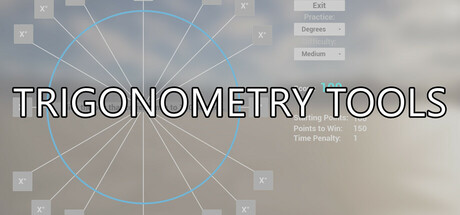
Shipped software, not a side-project demo.
The bar between “I built a thing” and “I shipped a thing” is real. Shipping to Steam means assembling a Steamworks application, passing review, producing a real store presence (capsules, screenshots, descriptions, trailer), wiring up a release branch with actual downloadable builds, and accepting that other people will install it and find what you missed. That's a different exercise from putting something on a personal website.
Trigonometry Tools is small on purpose, it does one educational job and does it well, but it went through the full Steam release process. It's a free download, in the Education category, and anyone with a Steam account can install it right now.
The unit circle is the perfect candidate for gamification.
Precalculus students hit a wall at the unit circle because there's no clever insight that makes the answer obvious; the cosine of 5π/6 is −√3/2 because that's where the radius lands, full stop. The only path to fluency is repetition until the standard angles, their equivalents in radians, and their sine and cosine values are available instantly. That kind of memorisation responds well to a spaced-repetition / reaction-time game loop: present a prompt, accept an answer, escalate difficulty, reward speed.
The game ships that loop in a way that respects the learner's time. It doesn't pretend to teach the concept from first principles, that's the textbook's job, and it doesn't pad the run with cosmetic progression for its own sake. It does the one thing the textbook can't: drill the reflex until the values are cached.
Small games are still real software.
From the outside, “a unit-circle trainer” sounds like an afternoon. From the inside, even a small Steam title requires: a build pipeline that produces a distributable Windows executable, input handling that doesn't feel janky on a laptop trackpad or a desktop with a controller, per-session state for streaks and progression, store-page marketing copy that survives Steam's review, and a deployment process that lets you push a fix without breaking installed copies. Those are all the same engineering muscles a contract client needs from a production system; the game is just where I exercised them on something I owned end-to-end.
It's free and it's on Steam right now.
If you've got a precalculus student in the house, or you're prepping a trig refresher yourself, install it and run a few sessions. The case study's value to this site isn't the game's mechanics, it's the proof that I take software from idea to public release, not just to demo.